Quick Answer
A liquor store compliance checklist includes a valid, displayed liquor license with tracked renewal dates; a written ID checking policy with staff enforcing strict age verification; completed RBS training records (where required by your state); required signage (age limits, pregnancy warning, and intoxication notice); delivery ID verification and driver training; and a quarterly audit of inventory, cash handling, and documentation. Working through these categories consistently helps prevent fines, failed inspections, and license suspensions.
Running a liquor store means dealing with more rules than almost any other type of retail business, and most of those rules leave very little room for error. A missed ID check, an expired license, or an untrained new hire working the counter can turn into a real problem fast.
The stores that get flagged during an inspection are rarely the ones breaking rules on purpose. They’re usually the ones without a system, where small things slip because no one is actually tracking them, until those small things add up to a fine or a license review.
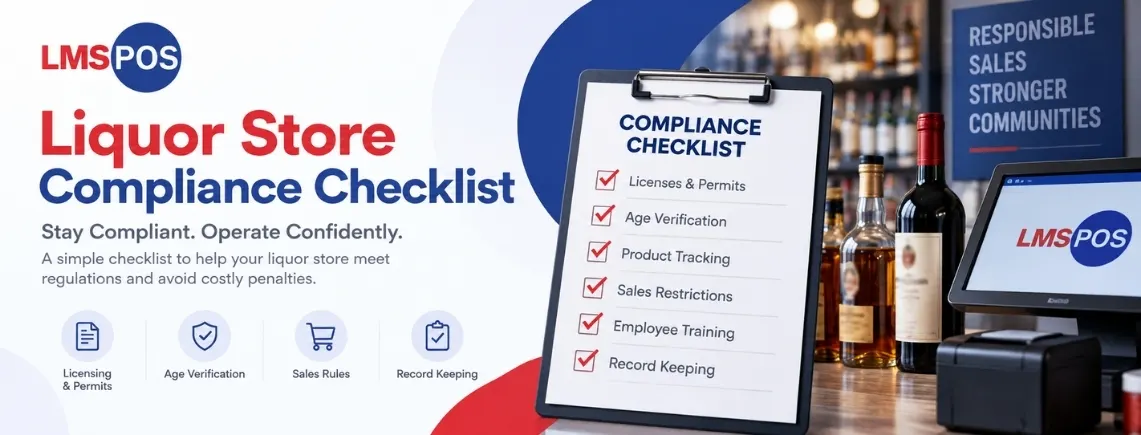
That’s exactly why you need a real liquor store compliance checklist, not just a mental note or a laminated sign taped to the register. If you’re running things on outdated equipment, a lot of this tends to fall through the cracks simply because your liquor store POS system isn’t built to catch it. Below is a practical, category-by-category checklist covering licensing, age verification, staff training, signage, delivery, and audits, so you can walk through it store by store, shift by shift.
Why a Liquor Store Compliance Checklist Matters?
Regulators aren’t looking to shut good businesses down. Most compliance checks exist to catch honest mistakes before they turn into real problems, like a cashier who forgot to check ID or a permit that quietly expired without anyone noticing. Here’s what’s actually at stake when compliance slips:
- Fines: even a first-time violation can come with a financial penalty
- License suspension: repeat or serious violations can pause your ability to sell entirely
- License revocation: in severe cases, you can permanently lose your right to sell alcohol
- Insurance impact: violations on record can raise premiums or affect coverage
- Delayed renewals: a flagged compliance history can slow down future license renewals
- Staff and customer safety risk: poor ID checks and untrained staff increase real liability
A written liquor store compliance checklist turns this from a list of risks into something your team can actively manage, one shift at a time.
Need help managing your liquor store operations? Contact us to see how LMS POS can help keep your store operations organized.
Liquor Store Compliance Checklist by Category
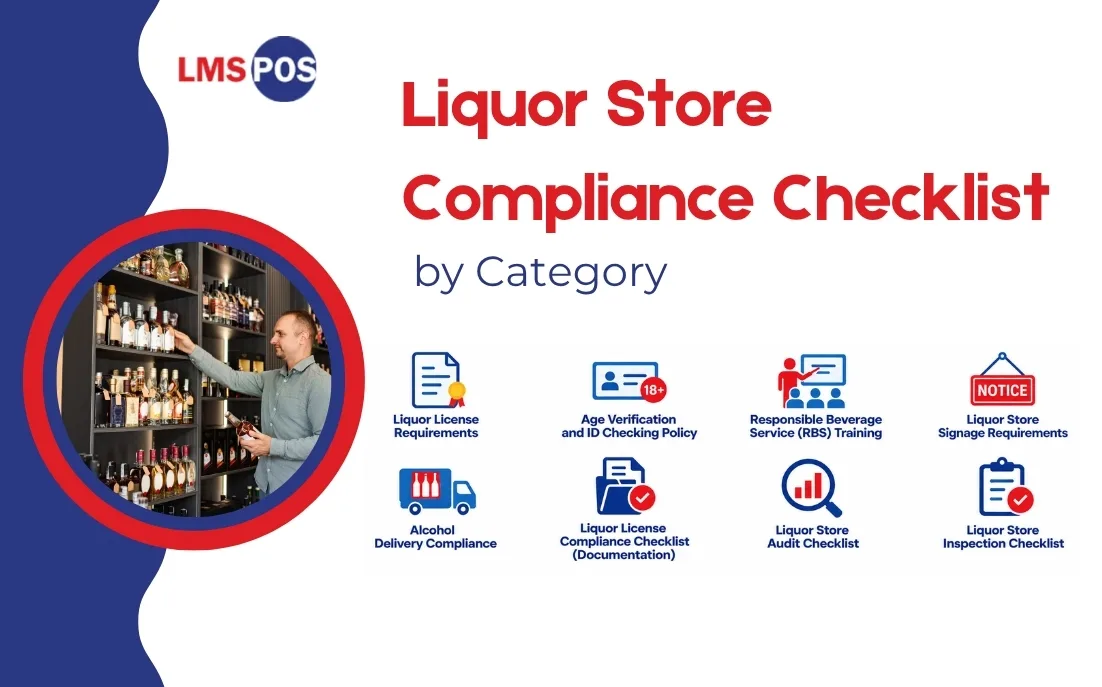
Every liquor store deals with the same basic categories of compliance, even though the exact rules shift depending on your state and county. Working through them one at a time, rather than treating compliance as one giant task, makes it far easier to catch gaps before an inspector does.
Here’s the full breakdown, with a checklist for each category.
1. Liquor License Requirements
Before anything else, your paperwork has to be right. Liquor license requirements vary by state and county, but a few things stay consistent almost everywhere.
- Current retail alcohol license displayed where customers and inspectors can see it
- Separate permits in place if you sell beer, wine, and spirits under different classifications
- Renewal dates tracked well ahead of expiration, not the week before
- Documentation on file proving the business meets zoning and location rules
- Calendar reminders set for every upcoming renewal
2. Age Verification and ID Checking Policy
This is where most compliance checks focus. Age verification laws for alcohol sales exist to prevent underage purchases, and enforcement agencies do send in test buyers, which is why liquor store age verification has become such a critical part of daily operations.
- Written ID checking policy for alcohol sales posted where staff can reference it
- Clear rule on acceptable ID types (state-issued, not expired, not a photocopy)
- Defined steps for what to do if an ID looks fake or altered
- Process for refusing a sale and documenting the refusal
- Clear escalation path if a customer pushes back
- Every employee checks ID for anyone who looks under the state’s age threshold, no exceptions
3. Responsible Beverage Service (RBS) Training
Responsible beverage service (RBS) training protects your staff in the moment they’re standing across the counter from someone intoxicated or underage. This doubles as your employee training checklist for alcohol sales, so run through it with every new hire, not just the register staff.
- All alcohol-selling staff completed RBS training or certification
- Staff can recognize signs of intoxication
- Staff know how to refuse a sale calmly and safely
- Staff understand state-specific rules on hours of sale and quantity limits
- Refusal and incident documentation process in place
- Signed training records kept on file for every employee
4. Liquor Store Signage Requirements
Liquor store signage requirements are easy to overlook until an inspector walks in and finds a required poster missing.
- Minimum age to purchase alcohol posted
- Warning about drinking during pregnancy displayed
- “No sales to intoxicated persons” notice visible
- Store hours of alcohol sale posted, if restricted by local law
- Monthly walkthrough scheduled to confirm all signage is up and readable
5. RBS Training Requirements Vary by State
Not every state legally requires RBS training, so it’s worth confirming where your store falls before assuming this is a universal box to check.
- Training is mandatory statewide in states including Alaska, California, Delaware, Illinois, Indiana, Louisiana, Montana, Nevada, New Mexico, Oklahoma, Oregon, Pennsylvania, Rhode Island, Tennessee, Utah, and Vermont, plus Washington, D.C.
- Some states only require certification for managers or owners, not every frontline seller (Arizona is one example)
- Many other states treat it as voluntary, often tying participation to lower liability insurance or added legal protection rather than a legal mandate
- Where there’s no statewide law, individual cities or counties can still impose their own requirement
- Confirm the exact rule with your state’s Alcohol Beverage Control (ABC) office or equivalent agency, since actual compliance depends on state and local law, not a national standard
6. Alcohol Delivery Compliance
If you offer delivery, either through your own drivers or a third-party service, alcohol delivery compliance adds another layer entirely.
- Drivers verify ID at the door before handing over alcohol
- No alcohol left unattended without ID verification
- Drivers trained on refusal procedures, same as in-store staff
- Delivery records kept: who delivered what, to whom, and when
- Third-party delivery partner’s compliance process confirmed in writing
- Local restrictions on delivery hours or zones reviewed
7. Liquor License Compliance Checklist (Documentation)
Beyond day-to-day operations, a liquor license compliance checklist should track the paperwork side of the business, the records you’d need to pull up on short notice, not just what’s posted on the wall.
- Current license and permit copies stored where you can find them in seconds, not just displayed at the counter
- Incident and refusal logs retained for the length of time your state requires
- Vendor and supplier licensing confirmed as legitimate before doing business with them
8. Liquor Store Audit Checklist
A liquor store audit checklist is the deeper review you run periodically, separate from your daily operations, to catch anything that’s slipped through the cracks financially. This usually starts with reconciling inventory against your sales records, which is exactly where liquor store inventory management tends to make the biggest difference, since that’s where most discrepancies show up first.
- Inventory reconciled against sales records
- Cash handling procedures reviewed for unexplained variances
- Full audit scheduled quarterly, not just before an inspection
9. Liquor Store Inspection Checklist
When you’re preparing for an actual liquor store inspection checklist, this is less about redoing your paperwork and more about making sure your team can hold up under direct questioning.
- Staff can clearly explain the ID checking process if an inspector asks directly
- Alcohol storage and display compliant with local rules
- A mock inspection run internally before the real one
Recommended Read: How to choose a POS system built for liquor stores
Common Liquor Store Compliance Mistakes to Avoid
Most compliance issues don’t come from stores ignoring the rules. They come from small habits that quietly build up until an inspector catches them. Here’s what tends to trip stores up the most:
- Trusting a glance instead of checking ID properly: a quick look isn’t the same as actually verifying the birthdate and expiration
- Letting license renewal dates slip: especially when the person who used to track it leaves or changes roles
- Assuming new hires “already know the rules”: skipping formal training because someone worked at a similar store before
- Forgetting to update signage after a remodel or layout change: old postings get covered, moved, or taken down and never replaced
- Not documenting refusals: a refused sale that isn’t logged looks the same as one that never happened if questioned later
- Treating delivery like it’s not “real” alcohol sales: the same age verification and refusal rules apply, but delivery often gets less oversight
- Only thinking about compliance right before an inspection: instead of keeping it part of the daily routine
Most of these mistakes are avoidable once you know to watch for them. That’s really the whole point of running through this checklist regularly, not waiting until something already went wrong.
Final Thoughts
Compliance isn’t the most exciting part of running a liquor store, but it’s the part that keeps your doors open. Nothing on this checklist is complicated; it’s just easy to let slide when things get busy and nobody’s specifically watching for it. The stores that stay out of trouble year after year usually aren’t doing anything special; they just treat this checklist as a habit instead of a once-a-year scramble before an inspection.
Run through it regularly, keep your paperwork where you can find it in thirty seconds instead of thirty minutes, and revisit training whenever staff turns over. Do that consistently, and liquor store regulatory compliance stops being something you worry about and just becomes part of how your store runs.
Looking for a simpler way to manage your liquor store operations? LMS POS helps liquor stores manage sales, inventory, and everyday operations from one system.
Frequently Asked Questions
What documents are needed to open a liquor store?
You’ll typically need a business license, a state or local alcohol retail license, and proof of zoning compliance. Some states also require a separate permit depending on the type of alcohol you plan to sell.
How often are liquor stores inspected?
This depends on your state’s Alcohol Beverage Control (ABC) agency and local licensing rules, since there’s no federal schedule. Some states inspect annually, while others only check after a complaint. Your local ABC board can confirm your exact schedule.
What happens if a liquor store fails a compliance check?
A minor paperwork gap might just get a warning and a deadline to fix it. Selling to a minor or an intoxicated person can lead to fines, a suspension, or in repeat cases, permanent revocation.
Is it illegal to sell alcohol without checking ID?
In most U.S. states, yes, if the customer appears under a set age threshold (often 30, even though the legal purchase age is 21) and no ID is checked. This applies regardless of the customer’s actual age, since the violation is based on the failure to verify. Exact rules vary by state, so confirm with your state’s ABC board.
Is RBS or responsible beverage service training legally required?
Yes, in states like California, Alaska, Illinois, Oregon, and Nevada, RBS training is mandatory by state law. Other states, such as Texas and Florida, only require it voluntarily or leave it to local jurisdictions, though it’s a smart safeguard either way.
Do delivery orders need the same compliance checks as in-store sales?
Yes, delivery drivers must verify ID at the point of handoff, just like a cashier would at the register. Skipping this step carries the same legal risk as an in-store sale.
How long should a liquor store keep compliance records?
Retention periods vary by state. Texas requires alcohol sale records be kept for at least four years, Arkansas requires delivery records for three years, and Minnesota and Kentucky require two years for purchase and sale records. Check your state’s ABC board for the exact requirement where you operate.

Dipesh Shrestha
Dipesh Shrestha is the co-founder of Compro Boston, the company behind LMS-POS. With over two decades of hands-on experience in point-of-sale (POS) deployment, payment processing ecosystems, and retail hardware logistics, he specializes in building secure, highly optimized checkout environments.