
Key Takeaways: How a Convenience Store POS Handles Lottery Sales
The state lottery terminal stays in charge of activation, validation, and settlement. Your POS handles your side of the counter:
- Separate departments: Scratch-offs, draw games, and payouts post to their own departments, so lottery cash stays apart from regular merchandise.
- Shift-change scans: Cashiers scan the next ticket on each active pack, and the POS works out tickets sold. Scan the next ticket on each pack, and the POS works out how many tickets sold and what you should have collected.
- Payout logging: Validate every winning ticket on the terminal first, then ring the payout through its own POS department.
- Daily reconciliation: Compare the POS shift-end report with the terminal’s daily report, then count the drawer.
- State settlement: Lottery money belongs to the state, so keep enough in your account for the scheduled transfer, often weekly.
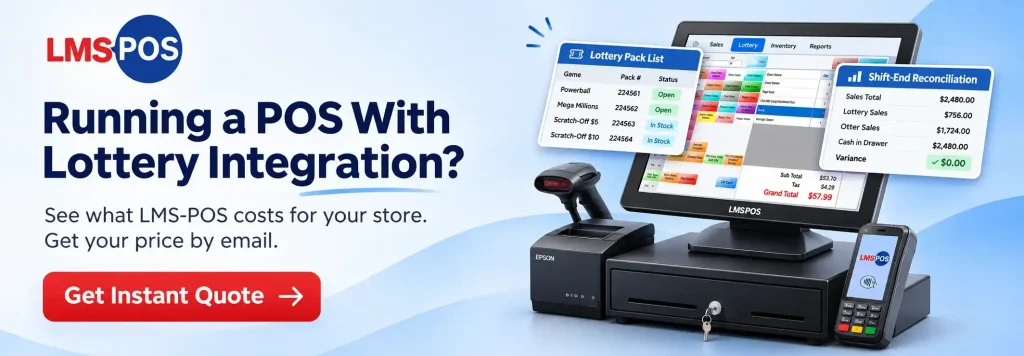
A convenience store POS system handles lottery ticket sales by ringing them in separate departments, tracking scratch-off packs by ticket number, logging payouts, and reconciling your totals at every shift.
Here’s what “lottery integration” means in practice. The POS does not replace the state lottery terminal. The terminal comes from a vendor such as IGT or Light & Wonder (Scientific Games), prints draw tickets, and reports to the state.
The best point-of-sale (POS) system records and reconciles your lottery sales, payouts, and pack counts alongside the terminal’s reports.
Some stores also use an instant ticket vending machine (ITVM) that sells scratch-offs on its own. At close, if the terminal’s reports match your POS reports, your drawer balances.
This guide shows how convenience store POS system handles lottery ticket sales, from the first scratch-off pack to the weekly state sweep.
What a Convenience Store POS System Needs to Handle Lottery Sales
A POS system with lottery integration needs five features. The state lottery terminal still handles activation, validation, and settlement. These features cover your side of the counter:
- Separate lottery departments: Scratch-offs, draw games, and payouts post to their own departments, so lottery cash stays apart from regular sales. Each department can have its own tax setting to match your state’s rules.
- Scratch-off pack tracking: The POS tracks each pack by game and ticket number, from receiving to settlement. At every shift change, cashiers scan the next ticket on each active pack, and the POS works out how many tickets sold.
- ID scanning for age checks: A 2D scanner reads the barcode on a driver’s license and prompts your cashier to check the customer’s age. The cashier still makes the final check.
- Payout logging: Validate each winning ticket on the terminal first. Then the POS records the payout from the drawer, so every dollar leaving the register is accounted for.
- Shift-end and daily reports: The POS shows expected lottery cash for each shift, so you can compare it with the terminal’s daily report.
How a Convenience Store POS Processes Lottery Sales
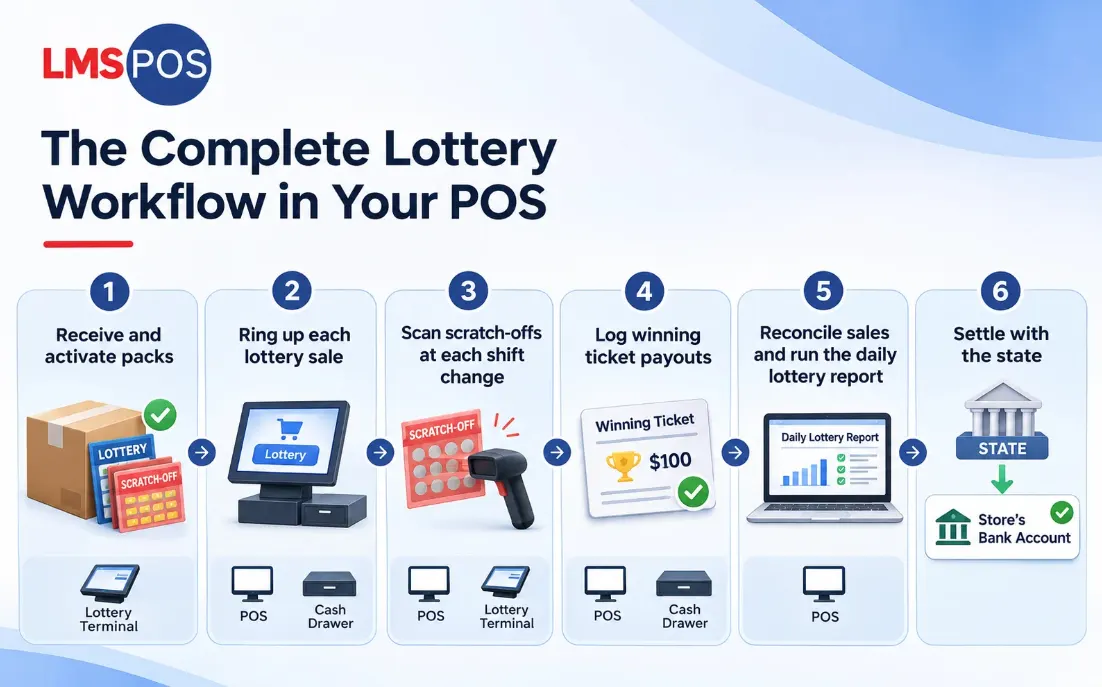
Lottery in your store moves through six stages, and your POS tracks or reports on each one so you can check your drawer against the lottery terminal at close:
- Receive and activate packs
- Ring up each lottery sale
- Scan scratch-offs at each shift change
- Log winning ticket payouts
- Reconcile sales and run the daily lottery report
- Settle with the state
Scratch-Off Ticket Inventory Tracking: Receive and Activate Packs
Scratch-offs arrive in packs (some lotteries call them books). You complete the official steps on the lottery terminal, and your POS tracks each pack through four stages:
- Received: You check the pack in against the delivery.
- Activated: You activate it on the terminal, then log it in your POS. Do this before you sell any tickets from it.
- Active: Cashiers sell from the pack, and the POS counts tickets sold at each shift change.
- Settled: You settle the pack on the terminal, often when it’s nearly sold out.
Do activation and settlement in both places on the same day, so your POS pack list matches the terminal. Steps, terminology, and settlement timing differ by lottery, so follow your state’s retailer instructions.
Ring Up Each Lottery Sale
Scratch-offs and draw games like Powerball or Mega Millions post to their own lottery departments, not your regular merchandise totals. For a draw game, the cashier prints the ticket on the lottery terminal and rings the same amount in the POS.
- Payment first: Lottery sales are generally final, so the cashier collects payment before handing over a ticket.
- Cash or card: Card rules vary by state. Massachusetts, for example, bars credit cards for lottery, and many stores take cash only to avoid card fees.
- Age verification: Your state sets the minimum age. The POS can prompt an ID check or read the PDF417 barcode on a driver’s license, but the check stays with your cashier.
- Sales tax: Lottery usually isn’t taxed like regular merchandise, but rules vary by state. Confirm yours before you set up the department.
Scan Scratch-Off Tickets at POS
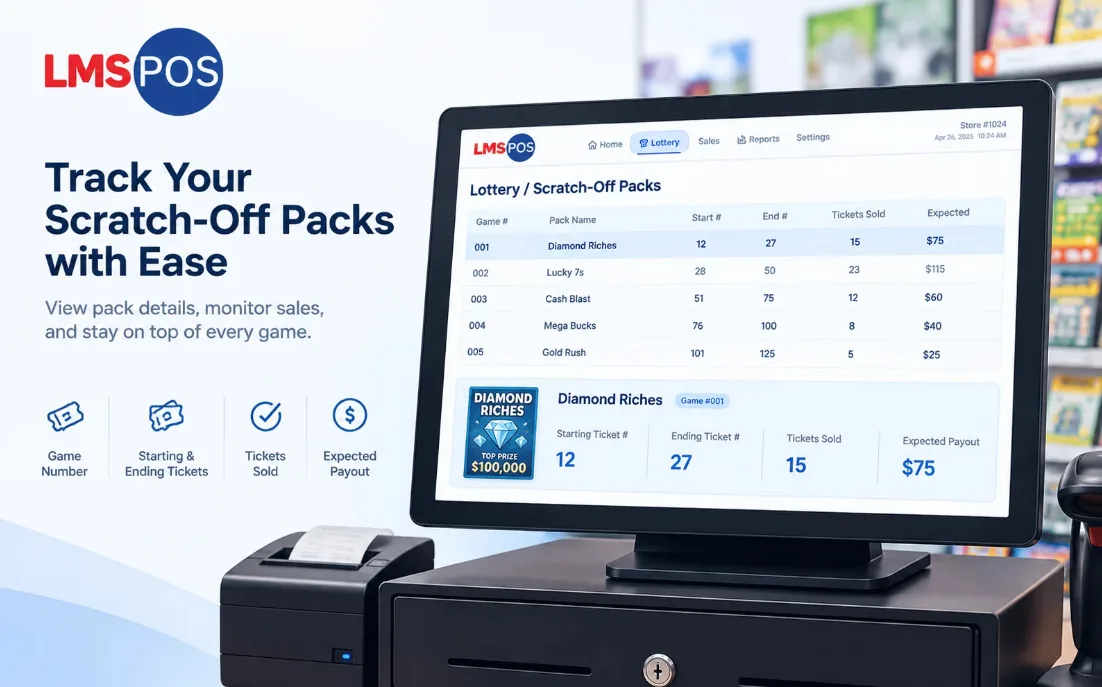
To scan scratch-off tickets at POS, take the next available ticket from every active pack at each shift change and read the long barcode on the back with your scanner. The POS compares the new number to the last one scanned and works out tickets sold.
Ticket numbers may count up or down, depending on your lottery’s rules and which end of the pack you start from. Follow your lottery’s pack instructions.
Example: a $5 game starts the shift at ticket #12 and ends at #27. That’s 15 tickets, so the POS expects $75 in sales for that game. If your register shows only $60 rung for it, three tickets are unaccounted for, and you know which game to check.
Log Winning Ticket Payouts
Most lotteries let you pay small prizes from the drawer, usually under $600, but the limit depends on your state and your retailer agreement. Always scan and validate the ticket on the lottery terminal before you pay.
Larger wins go through a lottery office or a mail-in claim. Some lotteries expect you to pay winners up to the limit, while others let you send a customer elsewhere if you lack the cash, so check your retailer agreement.
Ring each payout through its own POS payout department. That keeps lottery cash leaving the drawer separate from vendor payments and general expenses.
Reconcile Lottery Sales and Run the Daily Lottery Report
Here’s how to reconcile lottery sales daily:
- Run the terminal’s daily lottery report for draw sales and cashed tickets. Report names vary by lottery.
- Run the POS shift-end report for scratch-off sales, draw sales, and payouts.
- Compare the two reports. Draw sales and payouts should match.
- Count the drawer and compare it to the POS’s expected cash, which includes lottery sales minus payouts.
- Log any variance by shift, and by cashier if your reports show it.
Small gaps add up. A shortage of even a few dollars every day becomes a real loss by the end of the month. Lottery reconciliation software helps you narrow the gap to a game or a shift.
Picture a Friday night handoff: the drawer is short, and nobody scanned the scratch-off packs at shift change. Without that scan, it’s much harder to tell which game or which shift caused the gap.
Settle With the State (The Weekly Sweep)
Lottery money isn’t yours. You hold it for the state, like a holding tank. Most lotteries collect through an electronic transfer from your designated bank account on a set schedule, often weekly. Many people call this transfer the sweep.
The amount covers your draw sales and settled scratch-off packs, less your commission and any prizes you paid from the drawer. Scratch-offs bill when a pack settles, not ticket by ticket, so settling a pack on the terminal affects what leaves your account. The schedule and method vary by lottery.
Your POS lottery reports give you a close estimate, so you can keep enough in the account to cover the transfer. The state’s statement is the final number.
Want to see this workflow running in a real store? Schedule an LMS-POS demo and ask to walk through lottery pack tracking and shift-end reports.
Benefits of a POS System With Lottery Integration for Store Owners
A POS system with lottery integration gives you a place to start at close instead of a guess. Here’s what that means in the store:
- Shortages narrow to a scratch-off game and a shift. The POS shows which game’s ticket count doesn’t match the sales rung, so you start there instead of checking every pack.
- Cashiers stay accountable. When every shift scan and payout is recorded, a variance points to a shift, and to a cashier if your reports break results out that way.
- Shift handovers and closing get faster. One scan per active pack replaces counting tickets by hand, and closing comes down to comparing the POS shift report with the terminal’s daily report and counting the drawer.
- Discrepancies show up sooner. A pack that was never logged in the POS or a game with missing tickets can show up in that night’s report, not as a surprise on the lottery’s next statement.
- Cash-flow planning gets easier. POS lottery reports give you a close estimate of what the state will pull, so you can keep enough in the account.
Where LMS-POS Fits: Lottery Management for Convenience Stores
LMS-POS provides convenience store POS solutions for independent retailers across the US, with lottery management, age verification, and inventory control in one system.
Our convenience store POS system also supports lottery management, helping retailers track scratch-off books, record sales, and manage payouts. It doesn’t replace the state lottery terminal. It handles the store-side tracking and reconciliation. Here’s how:
- Lottery tracking: LMS-POS tracks active books, sales, payouts, and shift settlements. It also handles book receiving, activation, and returns.
- Reconciliation: Automated lottery reconciliation emails managers when shift numbers don’t add up, so you can catch a gap the same day.
- Age verification: Cashiers scan the customer’s ID with a 2D barcode scanner. The POS shows the minimum birthdate and prints an “ID Scanned OK” note on the receipt.
- Accountability: No-sale, void, and deleted-item reports log the cashier ID and time.
- Card fees: Integrated EMV card processing keeps card payments inside the POS, and dual pricing helps offset card fees on regular sales. Check your lottery’s card rules before you apply either to lottery tickets.
- Mobile inventory control: The free iPhone, iPad, and Android app lets you check inventory counts from the floor or stockroom without going back to the register.
- Technical support: Free technical supp
Final Thoughts
A lottery count that doesn’t match shouldn’t send you digging through every pack at the end of the night. Once you see how convenience store POS system handles lottery ticket sales, the routine gets simple: scan the packs at each shift change, log every payout, and compare your POS report with the terminal’s daily report.
That routine won’t stop every mistake, because no POS fixes a skipped scan. But it does shorten the search. Instead of recounting everything and hoping the numbers land, you start from the game and the shift where the count went off.
Want to see how this works with your own state’s terminal reports? Contact LMS-POS to book a demo and walk through pack tracking, payout logging, and shift-end lottery reports for your store.
Frequently Asked Questions
Can you use a regular POS for lottery sales?
You can ring the sale, but you’ll usually miss the tracking. A regular POS typically records only a dollar amount, so it can’t follow open packs, tickets left, or why the drawer is off. A POS system with lottery integration adds pack tracking, payout logging, and shift reports.
Do convenience stores make money on lottery tickets?
Yes, but the margin is small. In Massachusetts, retailers have been reported to earn a 5% commission on sales plus a 1% bonus on prizes cashed or won at their store, according to WGBH. Rates differ by state and game.
Do I need a separate lottery terminal if I have a POS?
Yes. The terminal connects to the state lottery, prints draw tickets, and validates winners, and the POS doesn’t replace it. The POS handles your cash, inventory, and reports.
Why is my lottery drawer short at close?
Usually it’s a skipped shift-change scan, an unlogged payout, or a sale that was never rung. Scan every active pack at each shift change and ring every payout, so a shortage points to one game and one shift. A POS can’t stop theft on its own, but it helps you spot a gap that night instead of on the lottery’s next statement.
What is the difference between instant tickets and draw games at the POS?
Instant tickets (scratch-offs) are tracked by pack and ticket number, and the POS works out sales from the scans at each shift change. Draw games like Powerball or Mega Millions print on the lottery terminal, so the cashier rings the same amount in the POS and you match it to the terminal’s daily report.
Can customers pay for lottery tickets with a credit card?
Card rules for lottery tickets depend on your state. In Massachusetts, state law prohibits credit card purchases of lottery tickets at the point of sale and allows debit cards. Other lotteries set their own rules, so check your state’s retailer rules and your retailer agreement before you set up card payments for lottery sales.

Dipesh Shrestha is the co-founder of Compro Boston, the company behind LMS-POS. With over two decades of hands-on experience in point-of-sale (POS) deployment, payment processing ecosystems, and retail hardware logistics, he specializes in building secure, highly optimized checkout environments.