
Retail Shrinkage at a Glance: How a POS System Helps
- Retail shrinkage is inventory you paid for but lose before you can sell it, and U.S. retailers lost an estimated $90 billion to it in 2025
- It comes from theft, errors, fraud, and damaged or spoiled stock, and most of it is preventable
- The main types are external theft, internal theft, administrative errors, vendor fraud, return fraud, spoilage, and digital fraud
- A POS system exposes many of these leaks early by tracking every sale, delivery, count, and write-off in real time
- LMS-POS logs voids, deleted items, and no-sale drawer openings by cashier, and its mobile app handles receiving, counts, and spoilage
- Calculate shrinkage as book inventory minus physical inventory, using your POS inventory as the book number
- Reduce shrink by counting often, receiving every delivery in your POS, reviewing register activity weekly, and adding physical security
Retail shrinkage is the loss of inventory a store has paid for but can no longer sell, caused by theft, fraud, paperwork errors, vendor problems, or damaged goods. It shows up as the gap between the inventory your records say you own and the inventory you can actually count. For example, if your system shows 10 bottles of the same vodka and only 8 are on the shelf, that is a shrinkage of two units.
Shrinkage in retail is not only theft. Inventory shrinkage also covers scanning and counting mistakes, supplier fraud, fraudulent returns, and goods that are damaged or expire. A POS system with real-time inventory is built to expose that gap early, because it records every sale, delivery, and write-off as it happens. This guide covers the causes, types, formula, and how a POS system helps you catch and reduce shrinkage.
How Much Does Retail Shrinkage Cost Retailers?
U.S. retailers lost an estimated $90 billion to shrink in 2025, and about 73% of it was preventable, according to Appriss Retail’s 2026 Total Retail Loss Benchmark Report.
That hurts more than the number suggests, because retail margins are thin. As an illustration, say a store earns a 5% net margin before shrinkage. A 1.5% shrink rate, close to the industry average, wipes out about 30% of that profit.
The damage goes beyond the missing stock:
- Bad inventory data: Forecasting and reordering run on wrong numbers, which leads to stockouts. Accurate, real-time POS inventory fixes the root of this.
- Lost sales: Empty shelves send shoppers to competitors.
- Higher prices: Retailers pass losses on to customers, which can push them away.
Many retailers treat shrink as a cost of doing business, but most of it is preventable. Shrink hits every kind of store, including liquor stores, grocery stores, convenience stores, and smoke and vape shops.
What Causes Retail Shrinkage? The Main Causes of Shrinkage in Retail
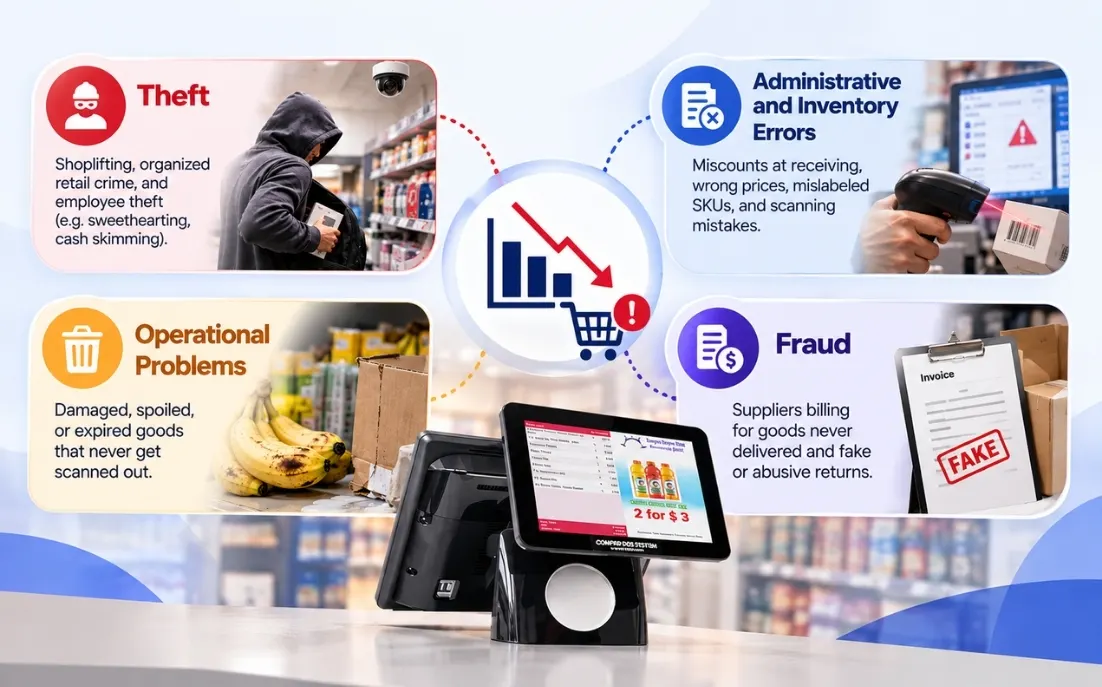
Retail shrinkage is caused by theft, errors, fraud, and damaged or spoiled stock. Theft is the biggest cause, but about a third of U.S. shrink in 2025 ($31 billion of $90 billion) came from inventory and operational errors, according to Appriss Retail.
The main causes are
- Theft: Shoplifting and organized retail crime by outsiders, plus employee theft such as sweethearting and cash skimming.
- Administrative and inventory errors: Miscounts at receiving, wrong prices, mislabeled SKUs, and scanning mistakes.
- Operational problems: Damaged, spoiled, or expired goods that never get scanned out.
- Fraud: Suppliers billing for goods never delivered and fake or abusive returns.
Here is how Appriss broke down the $90 billion:
Cause of shrink (U.S., 2025) | Est. loss | Share of $90B |
Employee theft | $26B | ~29% |
Inventory errors | $19B | ~21% |
Operational errors (damage, spoilage, process gaps) | $12B | ~13% |
Organized retail crime | $9B | ~10% |
Remainder (calculated: $90B − $66B) | $24B | ~27% |
The first four rows total $66 billion, which is the 73% Appriss classed as preventable.
The National Retail Federation (NRF) groups losses differently. Its 2023 Retail Security Survey, covering fiscal 2022, attributed about 36% of shrink to external theft, 29% to employee theft, and 27% to process and control failures and errors. Keep in mind that NRF’s figures come from a retailer survey and are several years old, and Appriss is a vendor of retail loss solutions. Treat both sets of shares as directional, not exact.
The practical takeaway: a store that only invests in anti-theft tools will miss the share of shrink that comes from receiving errors, miscounts, and unrecorded damage.
Receiving errors, wrong pricing, and unrecorded damage are easy to miss without good tracking. Contact LMS POS to track receiving and spoilage in one system.
Types of Shrinkage in Retail: 7 Main Types With Examples
Retail shrinkage falls into seven main types: external theft, internal theft, administrative errors, vendor fraud, return fraud, damaged or spoiled goods, and digital fraud. Each needs a different fix, so knowing which one is hurting you matters more than knowing the total.
1. External theft
External theft is stealing by people outside the business: casual shoplifters, tag-switchers, and organized retail crime (ORC) groups that steal in volume to resell. ORC rings often scout stores, target easily resold items, and hit several locations.
NRF’s 2025 Impact of Retail Theft & Violence report found that more than half of surveyed retailers saw ORC increase, and 83% said theft-related violence was the same or higher than the year before. Beyond cameras and locks, a POS can help prevent theft and waste by flagging unusual refunds, voids, and no-sale drawer openings.
2. Internal theft
Internal theft is stealing by staff. Common forms include taking stock from the back room, skimming cash, abusing discounts, and sweethearting, where an employee skips scans or gives free items to friends and family. Internal theft is hard to spot because employees know where the gaps are and can sometimes edit the records that would expose them. Strong POS security starts with accountability: a POS that logs no-sale drawer openings, deleted items, and voided invoices with cashier ID, date, and time makes it easier to trace who did what.
External theft vs. internal theft in retail
External theft | Internal theft | |
Who | Customers, ORC groups | Employees |
Typical methods | Concealment, tag switching, smash-and-grab | Sweethearting, voids, discount abuse, adjusting stock records |
Best controls | Visibility, product-level security, cameras, POS vs. physical count comparisons | Access control, cashier-level logs of voids, deleted items, and no-sales |
3. Administrative and process errors
Administrative errors, also called paper shrink, are mistakes in recording or handling inventory that make the stock record wrong even though nothing is stolen. They include miscounting at receiving, wrong price tags, mislabeled SKUs, bad data entry, and checkout scanning errors. These are honest mistakes, but they still show up as missing stock. Barcode scanning and receiving in a mobile app reduce manual entry, which is where most of these errors start.
4. Vendor fraud
Suppliers may bill for goods that were never delivered, ship fewer units than invoiced, send damaged or expired products, or collude with staff at the receiving dock. It can run unnoticed for a long time. Receiving each shipment in your POS at the door creates a record you can check against the invoice.
5. Return fraud and abuse.
Fake receipts, returning stolen goods, returning used items as new, and exploiting buy-online, return-in-store gaps all create losses. Appriss estimated about $100 billion in preventable loss from returns fraud and abuse in 2025, most of it abuse rather than outright fraud. Appriss counts this separately from its $90 billion shrink figure. For independent stores, clear return rules, such as requiring receipts, do most of the work.
6. Damaged, spoiled, or expired goods
Products broken in handling, thrown away without being scanned out, or left to expire stay in the system as sellable stock. Logging spoilage in your POS before items are thrown out keeps your records matching the shelf.
7. Digital and e-commerce fraud
Chargebacks, account takeover, and promo abuse add to shrink as retail goes omnichannel. This type sits mostly outside the register, so it is handled through your online store and payment provider rather than your in-store POS.
How a POS System Helps Prevent Retail Shrinkage
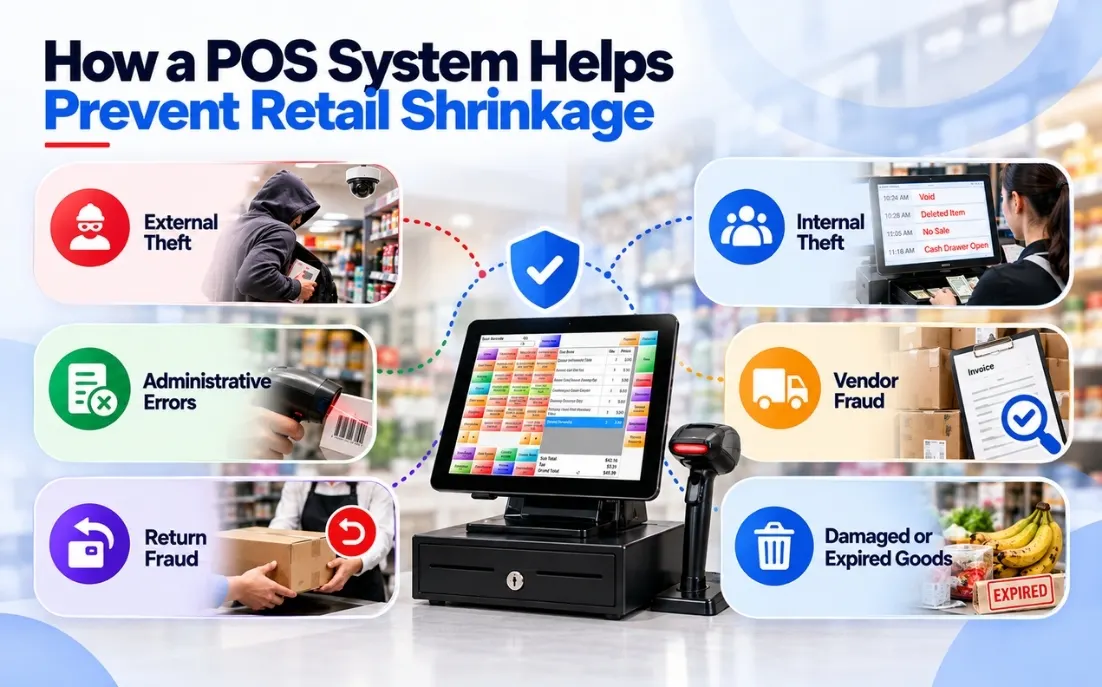
A retail POS system helps prevent retail shrinkage by keeping a live record of every sale, delivery, count, and write-off, so gaps show up in days instead of at the next full inventory. It can’t stop a shoplifter at the door, but it exposes many of the other leaks: voids and deleted items, receiving mistakes, miscounts, and unlogged spoilage.
Shrinkage type | What the POS does | LMS-POS feature |
External theft | Shows what’s missing sooner by comparing live stock with physical counts. Cameras and locks still matter. | Real-time inventory, physical counts in the mobile app |
Internal theft | Creates a record of who did what at the register | No-sale drawer openings, deleted items, and voided invoices logged with cashier ID, date, and time; shift discrepancy logs |
Administrative errors | Cuts manual entry at checkout, receiving, and counting | Barcode scanning, receiving and counts in the mobile app, group price editing |
Vendor fraud | Records what actually arrived, so you can check it against the invoice. | Shipment receiving in the mobile app |
Return fraud | Adds accountability, but your return policy does most of the work. | Voided invoices logged by cashier |
Damaged or expired goods | Gets write-offs into the system instead of the dumpster | Spoilage, damage, and expiration logging with itemized reports |
Internal theft and register activity
Most internal theft happens at the register or the cash drawer. LMS-POS tracks no-sale drawer openings, deleted items, and voided invoices with the cashier’s ID, date, and time, and keeps logs of shift discrepancies. Reviewing these by cashier each week makes patterns like repeated voids or frequent no-sales easy to spot.
Receiving, counts, and pricing errors
Many errors start at the back door. With the LMS-POS mobile app, staff can receive shipments, run physical counts, and adjust prices from the aisle on an iPhone, iPad, or Android device, so each number is entered once, right where the stock is. Group price editing updates a whole category or brand at once instead of item by item.
Damaged, spoiled, and expired stock
Log spoiled, damaged, or expired items in the app before they’re thrown out. LMS-POS generates itemized spoilage reports you can share with your accountant, and your records keep matching what’s actually on the shelf.
Lottery and cash discrepancies
If you sell lottery, LMS-POS tracks sales, payouts, books, and settlements, keeps lottery revenue separate from store sales, and alerts managers when shift numbers don’t reconcile. That replaces handwritten counts at the end of every shift.
Want to see this in your store? Schedule a demo and we’ll show you how LMS-POS tracks voids, receiving, and spoilage.
Where Shrink Hides in Liquor, Grocery, Convenience, and Smoke Shops
Independent stores lose inventory in different places depending on what they sell:
- Liquor stores: Breakage and miscounts when cases are broken into single bottles. LMS-POS supports case-break inventory, so cases and bottles stay in sync.
- Grocery stores: Spoilage and expiry, especially items thrown out without being logged. Spoilage logging closes that gap.
- Convenience stores: Lottery tickets and cash. Settlement errors and shift differences add up, which is why lottery tracking and shift discrepancy alerts matter.
- Smoke and vape shops: High-SKU stock with many variants and carton-versus-pack counts. Carton and pack tracking keeps those counts accurate.
See how LMS-POS is set up for a liquor store POS, grocery store POS, convenience store POS, or smoke and vape shop POS.
Shrinkage Formula: How to Calculate Retail Shrinkage
To calculate retail shrinkage, subtract your physical inventory count from the inventory your system says you should have. Then divide by net sales and multiply by 100 to get your shrinkage rate so you can compare stores and periods. Your POS inventory records give you the book inventory number, so you only need a physical count to run the formula.
Shrinkage ($) = Book inventory − Physical inventory
Shrinkage rate (%) = (Shrinkage ÷ Net sales) × 100
Follow these accounting rules so the result is reliable:
- Use the same valuation for every figure. All at retail price is the simplest. If you value inventory at cost, convert the shrink to retail value or divide by cost of goods sold instead of net sales.
- Compare on the same date. Measure book and physical inventory on the same count date, and use net sales since your last count.
- Know what’s in the book number. Book inventory should already include logged write-offs like spoilage and breakage, so the gap is unexplained shrink. Add the write-offs back if you want total shrink.
Some retailers divide by book inventory instead of sales. Both work, but they give different percentages, so pick one and use it consistently. Industry benchmarks, including NRF’s, are usually quoted as a percentage of sales.
Retail shrinkage formula example
A store’s POS shows $200,000 of inventory at retail price. A physical count on the same date finds $194,000. Net sales since the last count were $400,000.
- Shrinkage = $200,000 − $194,000 = $6,000
- Shrinkage rate (of sales) = $6,000 ÷ $400,000 × 100 = 1.5%
- Shrinkage rate (of inventory) = $6,000 ÷ $200,000 × 100 = 3%
A 1.5% rate sits just under NRF’s reported average of 1.6% of sales. Measured against inventory, the same loss looks like 3%, so always state which base you used.
How to Reduce Retail Shrinkage With a POS System
To reduce retail shrinkage, use your POS system to track every sale, delivery, count, and write-off, then review the data weekly. Pair it with consistent counts, tight receiving, staff accountability, and secured high-risk products. No retailer gets shrink to zero, but most can cut it.
- Use your POS as the single source of truth. Keep every sale, delivery, and adjustment in one POS inventory management system so your book inventory is accurate and updates in real time.
- Run POS-backed cycle counts more often. Run weekly or daily cycle counts on high-risk categories from the mobile app, and compare each count with the stock your POS shows.
- Receive every delivery in your POS. Check each delivery against the invoice, then receive it in the app at the door. Audit suppliers who short-ship.
- Review POS register activity by cashier. Each week, check voids, deleted items, and no-sale drawer openings by cashier ID to catch sweethearting and skimming.
- Build staff accountability with your POS. Give every employee their own cashier ID, train them on what’s tracked, and limit stockroom access.
- Log damage and expiry in your POS as it happens. Record spoiled, damaged, or expired items before they’re thrown out; rotate stock first-in, first-out; and use the itemized spoilage reports to see what’s costing you.
- Reconcile lottery and cash in your POS every shift. If you sell lottery, settle books, and check shift discrepancy alerts the same day.
- Back up your POS with physical security and return rules. Lock up or tether small, valuable items, keep sightlines clear, and require receipts for returns. If theft looks organized, share camera footage and incident patterns with local police.
Start with the biggest source of loss in your own data. Process errors, like receiving mistakes and unlogged waste, are often the cheapest to fix, and your POS data shows where to look first.
Final Thoughts
In short, retail shrinkage is inventory a store pays for but loses before it can sell. It comes from theft, errors, fraud, and damaged or spoiled stock, and U.S. retailers lost an estimated $90 billion to it in 2025, most of it preventable. The seven types, from external and internal theft to vendor, return, and digital fraud, show where those losses come from.
Once you know what retail shrinkage is and where it comes from, the next step is measuring it. Calculate your shrinkage rate with the shrinkage formula, compare it with the 1% to 2% benchmark, and sort your losses by type before choosing fixes. Start with the basics: tighter receiving, more frequent counts, and exception reports at the register.
Want these basics tracked for you? LMS-POS gives independent retailers inventory management and loss prevention reports for voids, deleted items, and no-sale drawer openings.
Frequently Asked Questions
What is retail shrinkage in simple terms?
Retail shrinkage is the difference between the stock a store should have and the stock it actually has, caused by theft, errors, fraud, or damage.
Is shrinkage the same as shoplifting?
No. Shoplifting is one cause of shrinkage. Employee theft, paperwork errors, supplier fraud, return fraud, and spoilage also count.
What is the biggest cause of retail shrinkage?
It depends on the survey. NRF’s fiscal 2022 data ranked external theft first at about 36%. In Appriss Retail’s 2025 data, employee theft was the largest itemized cause at $26 billion, followed by inventory errors at $19 billion.
What is a good shrinkage rate in retail?
There is no single “good” rate. NRF’s survey put the average at 1.6% of sales for fiscal 2022, up from 1.4% in 2021. Staying below the average is a good sign, and a rising rate is your signal to investigate. Rates vary by product category and store type, so track your own rate by period and by department, and always note whether you measured it against sales or inventory.
Can a POS system prevent shrinkage?
A POS system can reduce shrinkage, but it can’t eliminate it. It tracks stock in real time, logs voids, deleted items, and no-sale drawer openings by cashier, and records receiving and spoilage, so losses show up early. Physical security and staff training are still needed.
Can retailers eliminate shrinkage completely?
No, but most can reduce it. About 73% of U.S. shrink in 2025 was classed as preventable, according to Appriss Retail.
What is the difference between shrinkage and total retail loss?
Shrinkage covers unexpected inventory losses such as theft, errors, and fraud. Total retail loss is a wider measure that combines shrink with returns fraud and abuse and other operational leakage. Appriss put total retail loss at $796 billion in 2025.
Is shrinkage the same as shrinkflation?
No. Shrinkflation is when a company charges the same price, or a higher one, for a smaller amount of product. Shrinkage is inventory a retailer loses before it can sell.

Dipesh Shrestha
Dipesh Shrestha is the co-founder of Compro Boston, the company behind LMS-POS. With over two decades of hands-on experience in point-of-sale (POS) deployment, payment processing ecosystems, and retail hardware logistics, he specializes in building secure, highly optimized checkout environments.